
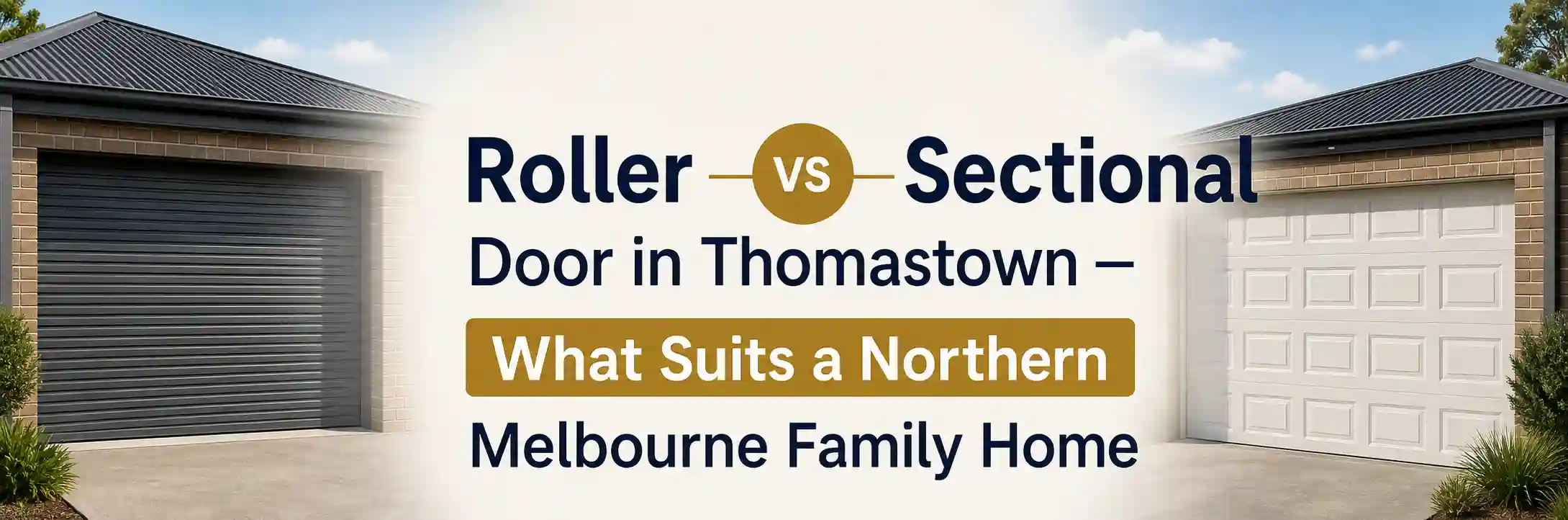
Roller vs sectional door in Thomastown is the most practically useful garage door comparison for a suburb whose housing stock is replacing its original tilt door systems and making a door type selection for the first time in decades. Unlike Richmond’s back lanes where roller doors are essentially the only practical option due to physical constraints, or Toorak’s large homes where sectional doors are the natural choice for wide openings and prestige aesthetics,
Thomastown’s family brick veneer homes present a genuine choice between roller and sectional doors whose outcome depends on the specific dimensions and configuration of each property’s garage. Understanding the advantages and limitations of each type in the context of a Thomastown family home is the practical foundation for a confident door selection.
How roller doors work in a Thomastown context
A roller door for a Thomastown brick veneer home travels straight up — the steel slats roll into a coil drum above the opening, and the door face moves parallel to the opening throughout its full travel. The drum housing sits above the opening inside the garage, and the door requires no outward swing in front of the opening and no horizontal track that runs along the ceiling into the garage interior.
For Thomastown’s older brick veneer homes where the garage ceiling is low — often 2.1 to 2.3 metres — the roller door’s minimal headroom requirement is a significant advantage. A sectional door requires 150 to 300 millimetres of clearance above the door opening for the track to transition from vertical to horizontal;
a roller door requires only the drum housing height, typically 200 to 300 millimetres above the opening height but without the horizontal track extending into the ceiling space. For a Thomastown garage where the ceiling height leaves the headroom requirement as a marginal question, a low-headroom roller door configuration may be the only practical automated option.
Roller doors in Thomastown’s residential context are available in manual and automated versions. An automated roller door uses a tubular motor inside the drum, which provides the quietest and most compact automation arrangement for a residential roller door system. For a Thomastown attached garage where motor noise is a consideration, the tubular motor’s internal position within the drum significantly reduces the motor noise compared to an external motor mounted on an overhead rail.
How sectional doors work in a Thomastown context
A sectional door for a Thomastown family home consists of horizontal panels that travel upward and then horizontally under the ceiling as the door opens, guided by a vertical-to-horizontal track system. The door panels, when fully open, are stored horizontally above the garage floor — parallel to the ceiling. This storage position requires sufficient internal garage depth for the panels to be fully retracted before the door is fully open, typically 300 to 400 millimetres of ceiling clearance plus the door height in internal depth from the garage face.
Sectional doors have several practical advantages for Thomastown’s newer townhouse developments and for larger original brick veneer homes where the internal dimensions support the track configuration. The panel-based construction allows for a wider range of visual profiles — flat panel, raised panel, timber-look — that present a different and often more visually substantial appearance from the street than a roller door. Sectional panels are also available with foam insulation between the outer and inner panel skins, which provides better thermal performance than a single-skin roller door curtain.
The automation system for a sectional door uses a ceiling-mounted drive rail motor that pulls the door through its travel via a trolley mechanism. This external motor configuration is slightly noisier than a tubular motor inside a roller door drum, which is a relevant consideration for Thomastown attached garages. A belt-driven motor rather than a chain-driven motor significantly reduces the operational noise of a sectional door automation system.
The Thomastown decision — key questions
Roller vs sectional door in Thomastown for a specific property is resolved by answering these questions in order:
- What is the internal ceiling height? Measure from the floor to the ceiling at the lowest point of the garage ceiling. If the ceiling is below 2.4 metres at any point in the area where the sectional door’s horizontal track would need to run, a roller door is the safer choice to avoid the headroom constraint. If the ceiling is 2.4 metres or above throughout, both types are structurally viable.
- How deep is the garage? A sectional door needs the garage to be deep enough for the fully retracted panels plus the vehicle length plus a safety margin. A standard single car sectional door panel retracted horizontally occupies approximately 400 millimetres of ceiling depth plus the door height. If the garage is shallow, the sectional door may partially obstruct the garage opening when fully retracted.
- Is the garage attached to the home, and is motor noise a consideration? For an attached Thomastown garage where the motor is audible in an adjacent room, a roller door with a tubular motor is the quietest standard installation. A sectional door with a belt-driven motor is the next quietest.
- Is the opening single or double? For single openings in Thomastown, both types are equally practical. For double openings of 4.5 metres or wider, sectional doors scale more effectively and present a more cohesive visual appearance.
- Is visual appearance or insulation a priority? Sectional doors offer more profile variety and better insulation options than standard roller doors. If kerb appeal and thermal performance are priorities for a Thomastown home, a sectional door’s design range provides more options.
Cost considerations for Thomastown homeowners
Roller vs sectional door in Thomastown has a clear cost relationship: a standard steel roller door is typically the lower-cost installation, and a sectional door with equivalent automation is typically higher. The cost differential varies with the specific products selected and the complexity of the installation, but as a general orientation:
- A quality steel roller door with tubular motor automation represents the most cost-effective complete automated installation for a standard single Thomastown garage.
- A sectional door with foam-insulated panels and belt-driven motor automation represents the highest-performance installation for a Thomastown attached garage where thermal performance and quiet operation are both priorities.
- The cost gap between roller and sectional narrows considerably when the roller door specification includes the same quality of automation and panel finish as the sectional alternative. The base product cost difference is smaller than the perception of “basic roller door” vs “quality sectional door” implies.
The industrial-adjacent context and door selection
Roller vs sectional door in Thomastown for homes adjacent to the suburb’s Industrial 1 Zone has a specific dust management dimension. Roller doors in dusty environments accumulate industrial particulate in the slat joints and in the drum, which can affect the smooth coiling of the door curtain over time.
Sectional doors in the same environment accumulate dust in the panel joints and in the track rollers. Both types require more frequent cleaning in industrial-adjacent locations than equivalent doors in cleaner environments. The choice between them on dust management grounds is essentially neutral — both require the same additional maintenance attention in Thomastown’s industrial-adjacent streets.
The roller vs sectional decision in Thomastown is ultimately made more confidently after a site measurement visit by the prospective installer. An installer who visits the property, measures the opening dimensions, confirms the ceiling height and internal depth, notes the attachment configuration and power supply position, and assesses the condition of the existing installation is one who can give a genuine and specific recommendation for the specific Thomastown garage rather than a generic answer based on assumed standard dimensions.
Thomastown’s mix of original 1960s brick veneer garages and newer townhouse developments means that no standard dimension assumption reliably applies — the site visit that confirms the actual dimensions before a door is ordered is always worth the brief time it takes and prevents the situation of discovering a dimension incompatibility after the product has been delivered to the property.
Conclusion
Roller vs sectional door in Thomastown is a practical decision guided by the specific dimensions of the garage, the noise sensitivity of the attached garage context, and the visual and insulation priorities of the household. For most Thomastown brick veneer homes replacing an original tilt door, a quality roller door with tubular motor automation is the most practical, cost-effective, and dimensionally flexible choice.
For newer townhouse developments and larger Thomastown homes with adequate ceiling height and garage depth, a sectional door with insulated panels and belt-driven motor automation is the higher-performance choice that suits a household where thermal efficiency and visual appeal are priorities alongside reliable daily operation.